TL;DR: Dogs don’t have true night vision like military goggles, but they see far better in the dark than humans. Their eyes are built for low light thanks to more rods, larger pupils, and a reflective layer called the tapetum lucidum. They see fewer colors than us but pick up motion and dim light better. They can’t see in complete darkness, but a moonlit trail or a dim hallway? They’ve got us beat.
If you’ve ever watched your dog navigate a pitch-black backyard like it’s noon, you’ve probably wondered what’s actually going on behind those glowing eyes. This article breaks down how canine vision works, what your dog actually sees at night, and answers the questions every pet owner eventually asks.
How Does a Dog’s Eye Actually Work?
A dog’s eye works on the same general blueprint as ours. Light enters the pupil, hits the retina at the back of the eye, and gets converted into nerve signals the brain can read. The cornea focuses and transmits light through the pupil, the lens fine-tunes it, and the retina handles the heavy lifting of detecting light and movement.
The differences start showing up in the details. Dogs have larger pupils than humans, which allows more light to enter the eye in low light conditions. Their retinas are packed with more rods, the cells that handle dim light and motion detection. They have fewer cones, which is why dogs see fewer colors than we do. Cones function better in bright light. Rods are much more sensitive to light, period.
The result is an eye that’s tuned for hunting at dawn, dusk, and night rather than spotting the difference between a red apple and a green one in midday sun. Evolution shaped canine vision around survival, not aesthetics.
Do Dogs Have Night Vision Better Than Humans?
Yes, dogs have night vision better than humans by a meaningful margin. Most veterinary sources put the gap at roughly five times. A dog can see in light that’s about one-fifth as bright as what humans need to see clearly. That’s a serious advantage on a dark trail or in a dim room.
The reason comes down to three things. First, those extra rods in their eyes mean their retinas convert light into nerve signals more efficiently in dim light. Second, their larger pupils let in more light. Third, and this is the cool one, dogs have a reflective layer in the back of their eyes that humans simply don’t have.
So when it comes to night vision, dogs win. They see well in low light, pick up movement faster, and don’t need a flashlight to find the back door at 3 a.m. But “better than humans” isn’t the same as “perfect.” There are still limits, and we’ll get to those.
What Is the Tapetum Lucidum and Why Does It Matter?
The tapetum lucidum is the reason your dog’s eyes glow when light hits them at night. It’s a reflective layer behind the retina that bounces light back and forth across the rods, giving them a second chance to absorb every photon. Less light goes to waste. More signal gets to the brain.
Think of it like a built-in light amplifier. When a beam hits your dog’s eye, the tapetum lucidum reflects light back through the retina, doubling the chance that those rods will catch it and convert light into electrical signals. That’s why dogs’ eyes look like they’re glowing green, yellow, or sometimes red eyes in photos taken with a flash. You’re literally seeing the reflective layer doing its job.
This is the single biggest reason dogs see better in the dark than we do. Humans don’t have a tapetum lucidum at all. Cats, deer, raccoons, and most other nocturnal or crepuscular animals do. It’s the universal hardware upgrade for seeing at night.
What Colors Can Dogs See?
Dogs are not colorblind in the cartoon sense of seeing only black and white. They see colors, just fewer colors than we do. Where humans have three types of cones (red, green, blue), dogs only have two (yellow and blue). This is called dichromatic vision, and it gives dogs a color palette similar to a human with red-green colorblindness.
So what does that mean in practice? Your dog sees blues and yellows clearly. Reds and greens get muddled into yellowish-brown tones. That bright red ball you throw across a green lawn? Your dog isn’t tracking it by color. They’re tracking it by motion, contrast, and brightness. If you want a toy your dog can spot easily, pick blue or yellow. They pop in canine vision.
Color vision is a trade-off in the dog eye. Fewer cones means less color discrimination, but it also means more room on the retina for rods. Dogs traded color richness for better vision in dim light. For a predator that hunts at dawn and dusk, that’s the right deal.
Can Dogs See in Full Darkness?
No, dogs cannot see in complete darkness. No animal can. Vision requires light, and if there’s zero light entering the eye, there’s nothing for the retina to convert into nerve signals. Even with a tapetum lucidum doing its best work, you need at least some photons bouncing around for the system to function.
What dogs can do is see in conditions humans would call “totally dark.” A moonless night with starlight only, a dim hallway with ambient light leaking under a door, or an overcast night in the backcountry are all environments where dogs see well and humans struggle. The ability to see in low light is impressive, but it’s not magic. Take away every photon and the lights go out for them too.
This is why dogs in pitch-black rooms (like a basement with the door shut) rely on hearing, smell, and memory to navigate. Their nose and ears are picking up the slack when their eyes can’t. Vision is one tool in the kit, not the whole toolkit.
Can My Dog See Me at Night?
Yes, your dog can see you at night in almost any normal household or outdoor setting. Unless you’re in a sealed, lightless room, there’s enough ambient light for your dog to make out your shape, your movement, and your general posture. They might not see your facial expression with crisp detail, but they know it’s you walking through the doorway.
Dogs also lean heavily on peripheral vision, which is wider than ours. Their eyes are located more toward the sides of the head, giving them a field of view around 240 degrees compared to our 180. Combine that with their motion-sensitive rods and you get an animal that can detect light and movement across a wide arc, even when it’s dim. Your dog probably sees you coming before you see them.
So if you’re worried about your pup getting spooked at night because they can’t see you, relax. They’ve got you in view. They also know your scent and your footsteps. Between the three senses working together, your dog has a clearer picture of where you are than you might think.
How Long Does 1 Hour Feel to a Dog?
This question doesn’t have a clean scientific answer, but the rough estimate is that 1 hour feels like roughly 4 to 7 hours to a dog. The reasoning comes from a few different angles. Dogs have higher flicker fusion rates, meaning they perceive more visual frames per second than humans. Their metabolisms run faster. Their lifespans are shorter, so each unit of time is proportionally larger relative to their total life experience.
That said, dogs don’t experience time the way we do. They don’t watch clocks, plan dinner, or count down to weekends. What they do experience is anticipation, routine, and absence. A dog left alone for an hour isn’t doing the math. They’re feeling the gap between when you left and when you’ll come back, filtered through whatever sensory cues (light, sound, smell of your return) they’re tuned into.
The takeaway for outdoor adventurers: if you’re leaving your dog at camp or in the truck for “just an hour,” remember that an hour to them feels significantly longer. Plan accordingly.
How Do You Say “I Love You” in Dog Speak?
Dogs don’t speak English, but they read body language, tone, and routine like a second language. The closest thing to saying “I love you” in dog speak is a slow blink combined with a soft, happy tone of voice. Slow blinks signal trust and calm. Dogs do this with each other and with humans they bond with. Match it with a gentle “good boy” or “good girl” and you’re communicating affection in a way they actually understand.
Other dog-speak expressions of love include leaning into them, scratching their chest (not the top of the head, which many dogs tolerate but don’t love), and using a calm, low voice. A long, gentle exhale near their face mimics a relaxed dog and tells them everything’s fine. Saying “good night” to your dog in a soft tone before bed reinforces the bond, even if the literal words mean nothing.
The biggest “I love you” in dog language? Showing up. Consistent presence, predictable routines, regular outdoor time, and shared adventures matter more to a dog than any specific word or gesture. They love what they can count on.
Do Dogs Need a Light on at Night?
In most cases, no, dogs do not need a light on at night. Their ability to see in dim light far exceeds ours, and a small amount of ambient light from a window, a streetlamp, or a digital clock is plenty for them to navigate the house. Most dogs sleep through the night just fine in total household darkness because they’re not relying on vision to feel safe. They’re relying on familiar smells, sounds, and the presence of their people.
There are exceptions. Senior dogs with cataracts or vision loss may benefit from a small night light, especially if they wander to find water or relieve themselves. Puppies in a new environment sometimes settle better with dim lighting. Dogs with anxiety, especially after a move or a major life change, can use a soft light as a comfort cue. But for a healthy adult dog with normal vision, the answer is simple. They’re built for the dark. Let them sleep in it.
How Does Canine Vision Hold Up in the Outdoors?
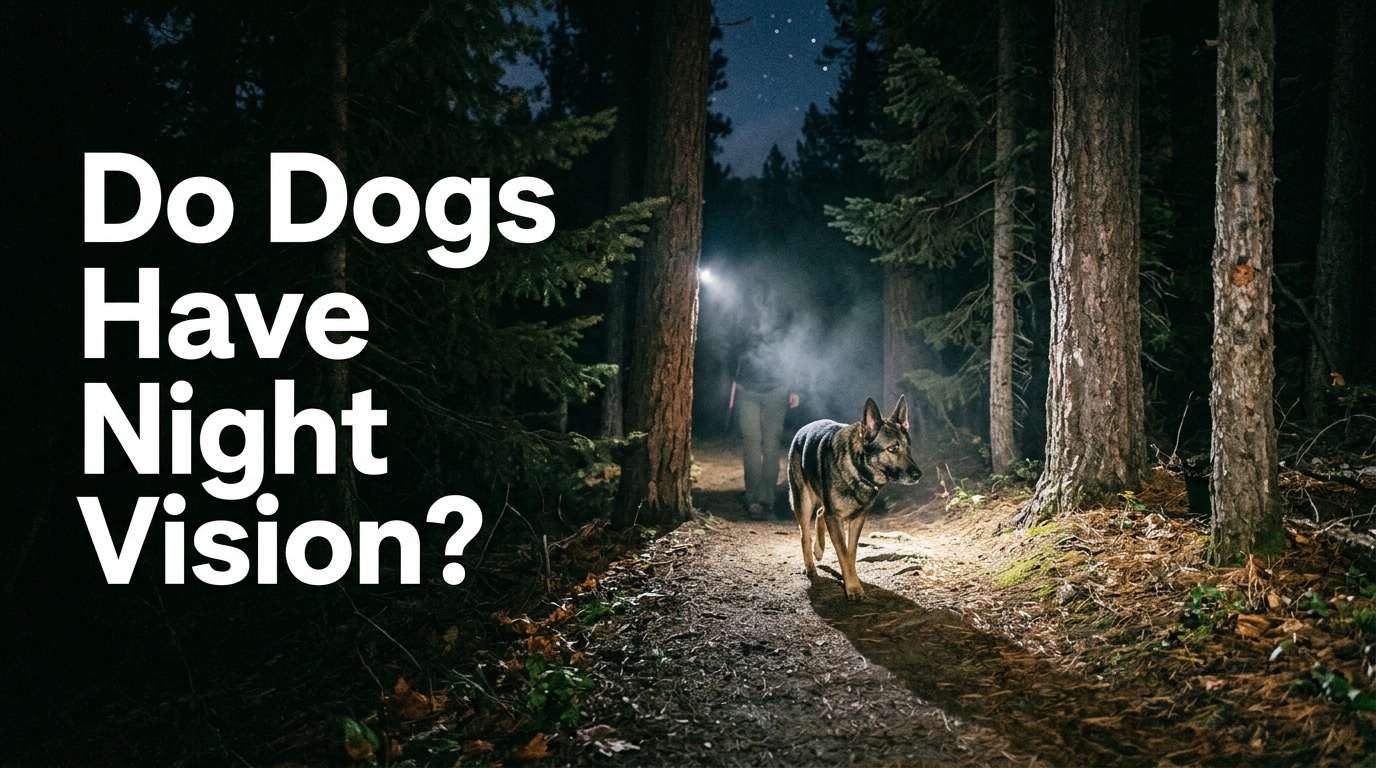
For anyone who hikes, hunts, camps, or runs trails with their dog, canine night vision is a real asset. On a moonlit trail, your dog will spot wildlife, terrain changes, and other hikers long before you do. Their lower visual acuity (they see fine detail less sharply than humans) is offset by their motion detection, peripheral vision, and ability to see well in low light. They’re not reading trail signs. They’re catching the rustle in the brush 40 yards out.
Dogs have less visual acuity than humans in good lighting, but the gap closes fast as the sun goes down. By dusk, your dog is the better-equipped one on the trail. They also have better depth perception in low light than humans do, partly because of those wider-set eyes and partly because their brains are wired to track moving prey through dim conditions. The overall package is built for crepuscular and nocturnal activity. That’s why so many working and hunting breeds excel at dawn and dusk hunts.
If you take your dog into the backcountry, trust their senses at night. They’ll often tell you something’s out there before you have any clue. That’s not paranoia. That’s hardware.
Quick Recap
- Dogs have night vision roughly 5x better than humans, but they cannot see in complete darkness
- The tapetum lucidum is the reflective layer that bounces light back across the retina, giving dogs their characteristic eye glow and a major night vision advantage
- Dogs see fewer colors than humans, mostly blues and yellows. Reds and greens look muddled
- More rods, larger pupils, and wider peripheral vision are the three big upgrades in canine vision
- Dogs can see you at night in almost any normal setting, plus they’re tracking your scent and footsteps
- One hour feels like 4 to 7 hours to a dog, so plan your time apart accordingly
- Slow blinks and a soft tone are the closest thing to saying “I love you” in dog speak
- Most dogs don’t need a light on at night, though senior dogs and pups in new environments may benefit
- On the trail at dusk and dawn, your dog has better vision than you do. Trust their senses.
- Dogs have less visual acuity in good light but win in low light conditions every time
About the Author