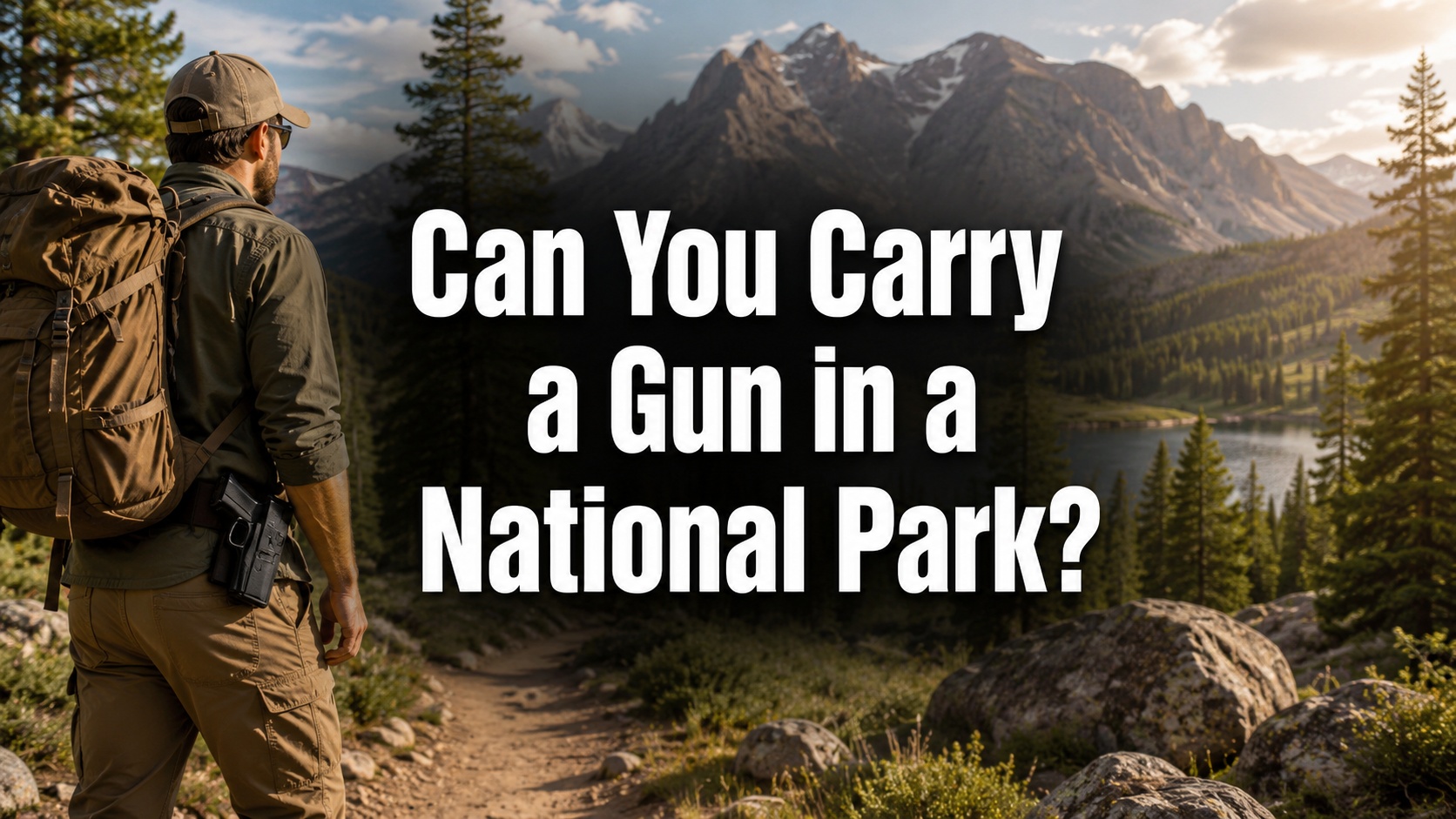
TL;DR: Yes, you can carry a firearm in a national park. Since 2010, federal law lets you possess a firearm in a national park as long as you are legally allowed to carry under the laws of the state the park sits in. But there are two firm limits: you cannot bring a firearm into any federal building inside the park (visitor centers, ranger stations, and the like), and you generally cannot discharge it, hunting is banned in most national parks and target shooting is prohibited. Carry is legal. Shooting is not.
Can You Legally Carry a Firearm in a National Park?
Yes. This surprises people, because there is a widespread assumption that all federal land bans guns. It does not.
The rule changed on February 22, 2010. A provision in the Credit CARD Act of 2009 amended federal law so that firearm regulations in national parks now mirror the laws of the state the park is located in. The legal authority is 54 U.S.C. § 104906. In plain terms: if you can legally carry a firearm in public in that state, you can carry it on the trails, campgrounds, and grounds of that state’s national parks.
That means the federal government does not issue a separate national park carry permit. There is no park-specific license. Your right to carry in the park rises and falls with the state’s carry laws.
Which State’s Laws Apply?
The state where the park is physically located, not your home state. This is the single most important thing to get right.
If you have a concealed carry permit from your home state, it only works in the park if the park’s host state recognizes that permit through reciprocity. Some states honor out-of-state permits broadly. Others recognize none. And in permitless (constitutional) carry states, you may not need a permit at all.
There is a complication worth flagging. Some national parks span more than one state. Yellowstone, for example, sits mostly in Wyoming but crosses into Montana and Idaho. When a park straddles state lines, the applicable carry laws can change depending on which part of the park you are standing in. If you are visiting a multi-state park, you need to know the laws of each state the park touches.
The short version of the “napkin math”: if you can legally carry in public in the state, you can generally carry on the park’s trails and campgrounds in that state. If you cannot carry in that state, the national park does not give you special permission.
Where Can’t You Bring a Gun Inside a National Park?
Here is the hard federal limit that applies no matter what the state allows. Under 18 U.S.C. § 930, firearms are prohibited inside federal facilities. Inside a national park, that covers a lot of buildings: visitor centers, ranger stations, government offices, fee collection booths, and maintenance facilities. Some parks extend the practical footprint to museums, gift shops, and restaurants operated on federal property.
These buildings are posted with signs at their public entrances. If you are carrying on the trail and want to step into a visitor center, you must secure your firearm first. Walking in armed is not a technicality. It is a federal crime punishable by up to a year in jail for a first offense.
The ground of the park is governed by state carry law. The buildings on that ground are governed by federal facility law. Keep those two separate in your head and you will stay on the right side of the line.
Can You Shoot a Gun in a National Park?
This is where national parks differ sharply from national forests, and it is the part people most often get wrong.
In most national parks, you cannot discharge a firearm. Under 36 CFR 2.4, the use or discharge of a firearm in a park area is prohibited unless specifically authorized. Hunting is banned in the large majority of national parks. Target shooting is not allowed anywhere in the national park system. The 2010 law that lets you carry did nothing to change the rules on using a firearm.
So the mental model is: you can possess it, you generally cannot fire it. The exceptions are narrow. A small number of parks have hunting authorized by specific federal statute, and in those you may hunt in accordance with NPS regulations and state game laws. Outside of those specific authorizations, keep it holstered.
This is the opposite of a national forest, where target shooting and hunting are broadly allowed. If you want to shoot, a national forest is the place, not a national park. It is worth knowing the difference before you plan a trip. We cover the forest rules in detail in our guide on carrying in national forests, because the two are constantly confused and the rules are genuinely different.
What About Bears and Wildlife Defense?
This is the reason a lot of people ask the question in the first place. You are hiking in Glacier or another park in bear country, and you want to know if you can carry for protection.
You can carry. Whether you should rely on a firearm for wildlife defense is a different and important question, and the honest answer runs against a lot of people’s instincts.
The National Park Service is direct about this: visitors should not consider firearms as protection from wildlife. There are two reasons. First, discharging a firearm in a national park is generally prohibited even in a wildlife encounter, and the burden falls on you to prove any shooting was genuine self-defense and not an illegal discharge or an attempt to harm a protected animal. Many park animals, including grizzly bears, are federally protected. Second, and more practically, firearms have a worse track record against charging bears than most people expect.
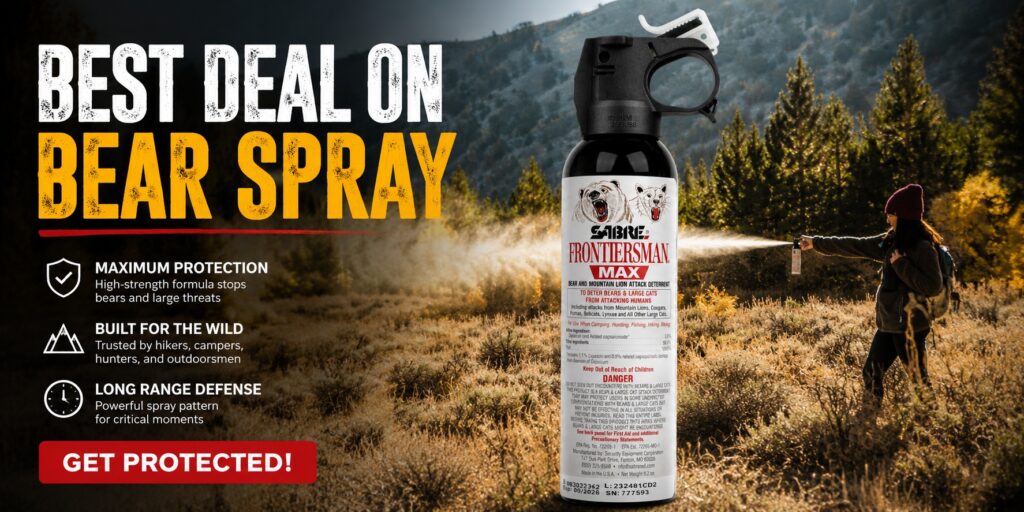
Bear spray is the tool the experts recommend. Studies of bear encounters have consistently found that bear spray (a specialized, high-volume pepper spray designed for bears) stops aggressive bear behavior more reliably than firearms, and it does so without the legal complications of firing a weapon in a park. It is lighter, faster to deploy under stress, and does not require the precision that hitting a charging bear demands. Many rangers carry it as their primary bear defense.
If you hike in bear country, the practical loadout most experienced backcountry travelers recommend is bear spray as your first line of defense, proper food storage to avoid attracting bears in the first place, and awareness and noise on the trail so you never surprise one. A firearm, where legal to carry, is a distant backup, not the plan.
Food, Bears, and the Best Defense of All
Since we are talking about bear country, the most effective safety measure has nothing to do with what you carry and everything to do with how you handle food.
Most dangerous bear encounters trace back to food. Bears that learn to associate humans with an easy meal become bold, and bold bears are dangerous bears. Store all food, trash, and scented items (including toothpaste and deodorant) in bear-proof containers or the food lockers provided at many parks. Never leave food unattended at a campsite. Cook and eat away from where you sleep. In parks like Glacier and Yellowstone, following the posted food-storage rules is not bureaucratic box-checking. It is the single biggest thing you can do to avoid a bear encounter entirely.
The best gun in a bear encounter is the encounter that never happens because you stored your food correctly.
Can You Carry a Gun in a National Forest?
Yes. And the legal reasoning is the same one that applies in national parks.
The U.S. Forest Service does not run its own firearms permitting system. It defers to the law of the state and local jurisdiction where the forest sits. If you can legally carry in that state, you can legally carry in the national forest inside its borders. If the state requires a permit, you need one. If the state is a permitless carry state, you do not.
That means the question is never really “what are the national forest rules.” It is “what are the rules in this state, and does my permit work here.”
A few practical consequences follow from that.
Your permit’s reciprocity matters more than the land designation. A permit valid in your home state may or may not be recognized where the forest is. Reciprocity agreements between states govern this, not the Forest Service.
State lines cut through public land. Several national forests span two or more states. Your legal status can change partway through a hike with no signage marking the transition. Long-distance trail users on the Appalachian Trail or Pacific Crest Trail deal with this constantly.
Federal buildings remain off limits. Ranger stations, visitor centers, and administrative offices are federal facilities. Firearms are prohibited inside them regardless of what state law allows outside the door.
National Park vs. National Forest: What Actually Differs
Most people use the two terms interchangeably. The agencies that run them do not, and neither does the law.
Carry rules are effectively identical. Discharge rules are not, and that is where the real difference lives.
| National Park | National Forest | |
|---|---|---|
| Concealed carry | Legal, per state law | Legal, per state law |
| Open carry | Legal, per state law | Legal, per state law |
| Permit required? | Depends on state | Depends on state |
| Hunting | Prohibited in most parks, limited exceptions by permit | Allowed during state-regulated seasons |
| Target shooting | Prohibited | Permitted in designated areas |
| Firearms in federal buildings | Prohibited | Prohibited |
The short version: a national park is carry yes, shoot no. A national forest is carry yes, shoot usually yes.
That distinction catches people out. A hunter who assumes park and forest rules match will either pass up legal opportunity or commit a federal violation, depending on which direction the confusion runs.
Forest Service Discharge Restrictions
Permitted does not mean unrestricted. Forest Service regulations prohibit discharging a firearm in several specific circumstances:
- Within 150 yards of a residence, building, campsite, developed recreation site, or occupied area
- Across or onto a road or body of water
- Into or within a cave
- In any manner that places a person in danger
Tracer and incendiary ammunition are prohibited outright. Seasonal fire restrictions can also suspend target shooting entirely, and those orders can appear on short notice during drought conditions.
Overlapping Designations Are the Real Trap
A national forest boundary is not the only designation that applies to a piece of ground. Several others can sit on top of it, each with its own rules.
Designated Wilderness Areas. A Regional Forester or Forest Supervisor has authority to issue a special local order prohibiting the mere possession of a firearm inside a Wilderness Area. This is uncommon but it is real, and it applies to possession, not just discharge.
State Wildlife Management Areas. Where a WMA overlaps national forest land, state wildlife regulations generally prohibit firearms unless a scheduled hunt is in progress. Even during an open hunt, restrictions often apply to which firearms are allowed.
Adjacent federal land. National forests frequently border BLM land, wildlife refuges, and national park units. Boundaries are not always marked in a way you will notice while moving through terrain.
The workable habit is to check the specific forest unit’s website before a trip rather than relying on general national forest rules. Individual forests publish their own orders, and those orders change.
Before You Pack a Firearm for the Park
A quick pre-trip checklist so you stay legal and safe.
Confirm it is a national park, not a national forest. The rules on discharge are completely different, and the names are often similar. Adjacent units (like a national park and a national forest sharing a name) can have opposite rules on shooting.
Know the carry laws of the state the park is in. Not your home state. If the park spans multiple states, know the laws for each.
Confirm your permit’s reciprocity. Your home-state permit is only valid if the park’s host state recognizes it, or if that state allows permitless carry.
Never carry into a federal building. Visitor centers, ranger stations, and offices are off-limits and posted. Secure your firearm before entering.
Do not plan to shoot. Discharge is prohibited in most parks. If self-defense against wildlife becomes necessary, be prepared to justify it, and understand that bear spray is the recommended and more effective tool.
Store your food correctly. In bear country, this matters more than anything you carry.
Carrying a firearm in a national park is legal in most cases, but it comes wrapped in more rules than the trails let on. Know the state law, respect the building line, keep it holstered, and let food storage and bear spray do the real work of keeping you safe out there.
Verify Before You Travel
Carry reciprocity, permitless carry status, and state-level restrictions change regularly. Several states have shifted their carry framework in recent years, and forest-specific closure orders can be issued mid-season.
Check three things before any trip where you plan to be armed:
- Current carry law in the state where the land sits, including whether your permit is recognized
- The specific forest or park unit’s website for local orders and seasonal restrictions
- Whether any overlapping designation, such as a Wilderness Area or WMA, applies to where you will actually be
This information is general guidance, not legal advice. Firearm law is state-specific and changes often. When the answer matters, verify it against the current text of the law or consult an attorney licensed in that state.
About the Author