Water is easy to take for granted.
Turn the faucet. Fill a glass. Water the garden. Take a shower. Hook up the RV. Pack a few bottles for a weekend outside.
Most of the time, we barely think about where that water came from.
That changes quickly during a drought, broken water main, boil-water advisory, extended blackout, wildfire, campground water failure, or another disruption.
It is also why alternative water technologies are getting more interesting.
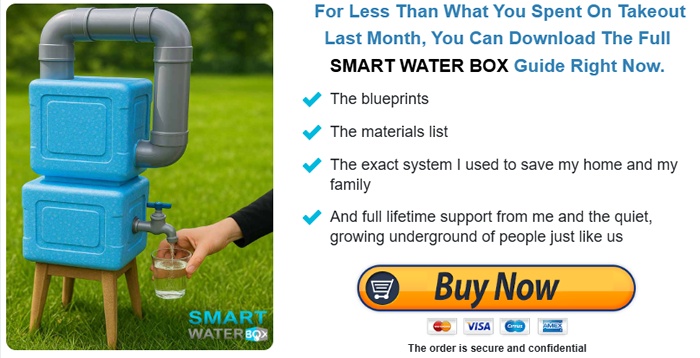
SmartWaterBox is a digital DIY guide that shows buyers how to build an atmospheric water generator, a system designed to extract moisture already present in the air and condense it into liquid water.
The advertiser describes it as a relatively inexpensive approach to creating an independent water source without drilling a well or connecting the device to a municipal water line.
That sounds intriguing.
But does the Smart Water Box really work? Is atmospheric water generation legitimate technology? What does the $39 purchase actually include? And what should you know before treating one as part of your water security plan?
That is what this SmartWaterBox review will cover.
SmartWaterBox Review: Our Quick Take
SmartWaterBox makes the most sense when viewed as a DIY alternative water project, not as a magic machine that provides unlimited free water anywhere on Earth.
The underlying concept is legitimate.
Atmospheric water harvesting is a real field of technology, and condensation-based atmospheric water generators, commonly abbreviated AWGs, convert water vapor in ambient air into liquid water.
SmartWaterBox attempts to bring that concept down to the household DIY level.
For people interested in water security, sustainability, off-grid living, emergency preparedness, cabins, homesteading, RV life, or simply learning how alternative water systems work, that is an appealing idea.
There is one major reality to understand from the beginning.
| SmartWaterBox at a Glance | Details |
|---|---|
| Product | SmartWaterBox |
| Product Type | Digital DIY guide |
| Technology | Atmospheric water generation |
| Main Purpose | Build an alternative water source using atmospheric moisture |
| Physical Generator Included | No |
| Advertised Guide Price | $39 |
| Advertised Build Cost | Less than $106 |
| Advertised Maximum Output | Up to 40 gallons per day |
| Plumbing Connection Required | No municipal water connection required |
| DIY Work Required | Yes |
| Climate Dependent | Yes |
| Power Considerations | Yes |
| Bonuses | Two additional DIY guides |
| Support | Advertised lifetime support |
| Refund Policy | Advertised 60-day money-back guarantee |
| Best Fit | DIYers, homeowners, homesteaders, outdoor enthusiasts and preparedness-minded buyers |
For the right buyer, I like the premise.
Instead of buying another container that merely stores water, SmartWaterBox teaches a method intended to generate additional water.
That difference is important.
See the Current SmartWaterBox Offer
What Is Smart Water Box?
Smart Water Box is a downloadable guide for building a DIY atmospheric water generator.
An atmospheric water generator extracts moisture from the surrounding air.
It does not need to begin with water from a faucet, river, lake, rain barrel, or well.
Instead, the raw material is water vapor in the atmosphere.
The basic concept is familiar to anyone who has watched water appear on the outside of an ice-cold glass.
The glass is not leaking.
Water vapor in the surrounding air reaches the cold surface, cools below its dew point, and condenses into liquid water.
A condensation-based atmospheric water generation system applies that principle deliberately.
Air enters the system.
Moisture condenses.
The liquid is collected.
For potable use, appropriate treatment and sanitary storage are also necessary.
SmartWaterBox is designed to show ordinary DIY users how to put those pieces together using accessible components rather than purchasing an expensive commercial atmospheric water generator.
Is Atmospheric Water Harvesting Real?
Yes.
This point tends to get buried because some Smart Water Box advertising uses extremely dramatic language.
Forget the advertising story for a moment.
Atmospheric water harvesting is real technology.
Researchers are actively developing systems that harvest moisture from air using condensation, desiccants, sorption materials and other methods.
The more precise description for the Smart Water Box concept is a DIY atmospheric water generator.
There is nothing mysterious about the central principle.
There is moisture in air.
Under the right conditions, that moisture can be extracted and collected as liquid water.
The real questions are efficiency, output, climate, energy use, construction quality, treatment and cost.
Those are much more useful questions than whether water can physically be extracted from the atmosphere.
It can.
How Does Smart Water Box Work?
The Smart Water Box relies on atmospheric water generation rather than a traditional water source.
At a basic level, a condensation-style system pulls air across a cold surface.
When that surface is below the dew point, some of the water vapor in the air changes phase from vapor to liquid.
That liquid can then be collected in a reservoir.
The Smart Water Box guide is intended to explain how to construct such a system using readily obtainable components.
According to the advertiser, the materials include simplified blueprints, a tools and materials list, assembly instructions, water safety and storage information, troubleshooting guidance and ongoing support.
This makes the product fundamentally different from a conventional water filter.
A water filter cleans water you already have.
An atmospheric water generator attempts to create a new supply of collected water from moisture in the air.
Both can play useful roles.
They simply solve different problems.
Does the Smart Water Box Really Work?
This is the question behind almost every SmartWaterBox review.
The answer needs a little context.
The scientific principle works
Atmospheric water generation is established technology.
Humidity contains water.
Cooling humid air can cause water vapor to condense.
Commercial systems already use variations of this process.
So SmartWaterBox is not based on imaginary physics.
Your water output will depend on conditions
Where things become less predictable is how much water a particular homemade system will produce.
The SmartWaterBox advertiser promotes output of up to 40 gallons of water per day.
That is an “up to” figure, not something I would interpret as a guaranteed daily yield in every location.
Atmospheric water production is strongly influenced by humidity and temperature.
Warm, humid environments generally give a condensation system much more moisture to work with.
Cold or extremely dry conditions make extracting meaningful quantities more difficult.
Your build quality, airflow, cooling capacity, operating time and available energy will matter as well.
So my answer to “Does Smart Water Box really work?” is this:
The water-generation principle is absolutely real. Whether your particular Smart Water Box produces a little water or a lot of water will depend heavily on how well it is built and where you operate it.
That is a much more realistic reason to consider the project.
Why Water Security Is Becoming a Bigger Issue
Water scarcity is not exclusively a desert problem.
Homes depend on an interconnected system of reservoirs, wells, rivers, treatment plants, pumps, pipelines, electricity and local infrastructure.
Drought can pressure that system.
Population growth can pressure it.
Agriculture and industry compete for water in many regions.
Wildfires can damage watersheds and affect water quality.
Extreme weather can interrupt service.
Aging infrastructure can fail.
And new sources of industrial demand are increasingly part of local conversations about water.
Data centers are adding a new wrinkle
The expansion of AI and cloud computing has put data-center water consumption under growing scrutiny.
Some data centers use substantial amounts of water directly for cooling, while electricity generation adds an indirect water footprint. The impact varies enormously depending on cooling technology, climate, energy source and location, but it can become locally significant in water-stressed communities.
This does not mean data centers are “taking all the water.”
Agriculture and other sectors remain much larger users nationally.
The more useful takeaway is that local freshwater resources have many competing demands.
That makes household water conservation and resilient alternative water sources increasingly relevant.
For AlphaSteward, that is where SmartWaterBox becomes particularly interesting.
It sits at the intersection of sustainability and self-reliance.
SmartWaterBox and Water Conservation
At first glance, generating water and conserving water might seem like separate subjects.
They are really two sides of the same problem.
Conservation reduces demand.
Alternative water sources increase supply.
A resilient household should think about both.
You might install low-flow fixtures.
Fix leaks.
Use drought-tolerant landscaping.
Capture rainwater where practical.
Reuse suitable greywater where permitted.
Store emergency drinking water.
Filter naturally available water when necessary.
And investigate atmospheric water harvesting.
No individual technique has to solve the entire problem.
The goal is to reduce dependence on one source.
SmartWaterBox for Drought Protection
This may be one of the product’s most appealing uses.
Rainwater harvesting is fantastic when rain actually falls.
During a serious drought, that becomes the obvious weakness.
An empty rain barrel cannot collect yesterday’s rain.
An atmospheric water generator works differently.
It extracts water vapor from ambient air rather than waiting for precipitation.
That does not mean drought conditions are automatically ideal for atmospheric water generation. Many drought-prone environments also experience very low humidity, which can significantly reduce water production.
But atmospheric moisture and rainfall are not the same resource.
That distinction creates another option.
And when it comes to water security, having another option is valuable.
Smart Water Box vs Rainwater Harvesting
I would not choose one and reject the other.
They complement each other.
| Factor | SmartWaterBox | Rainwater Harvesting |
|---|---|---|
| Needs Rain | No | Yes |
| Uses Atmospheric Moisture | Yes | Indirectly |
| Storage Required | Yes | Yes |
| Roof or Catchment Area | No | Usually |
| Climate Sensitive | Yes | Yes |
| Energy May Be Required | Yes | Usually little or none for basic collection |
| Water Treatment May Be Needed | Yes | Yes |
| Best Role | Alternative water production | Bulk collection during rainfall |
In a wetter climate, rain collection can provide large volumes very efficiently.
During periods without rain, atmospheric water generation could potentially provide another source.
That is how I would approach water resilience.
Build complementary systems rather than searching for one perfect system.
Smart Water Box vs Bottled Water
Bottled water wins one category easily.
Convenience.
Open it and drink.
That makes stored water an essential part of emergency planning.
But bottled water is a finite resource.
If you store 30 gallons and use five gallons, you have 25 gallons left.
Then 20.
Then 15.
Eventually the supply reaches zero.
Atmospheric water generation attempts to solve a different problem by replenishing water rather than merely storing it.
That does not make SmartWaterBox a replacement for stored water.
Quite the opposite.
Store water first. Add water-production capability as another layer.
The two work better together than either does alone.
SmartWaterBox for Cabins and Off-Grid Living
This is probably one of the most natural audiences for the product.
A remote cabin may not have easy access to municipal water.
Drilling a well can be expensive or geographically impractical.
Rainwater harvesting depends on local precipitation.
Hauling water works, but it requires transportation, storage and repeated trips.
An atmospheric water generator introduces another possibility.
For an off-grid property, however, water independence and energy independence have to be considered together.
If your AWG uses electricity for fans, refrigeration or pumps, you need to supply that electricity somehow.
Solar panels, batteries, a generator or another independent power system may become part of the larger setup.
That is not necessarily a flaw.
It simply means an off-grid homestead should be designed as a system, not as a collection of isolated gadgets.
- Water.
- Energy.
- Food.
- Waste.
- Shelter.
- Heat.
Each one affects the others.
Could SmartWaterBox Be Useful for RV Owners?
Potentially.
RVers understand water limitations better than most homeowners.
Your freshwater tank has a fixed capacity.
Every shower, cup of coffee, dishwashing session and toilet flush subtracts from it.
Refilling may be easy at a developed campground and considerably more annoying when boondocking.
Atmospheric water generation therefore has obvious appeal.
But an RV owner should think realistically about space, power draw, noise, humidity and actual production.
A homemade AWG is not automatically a tiny portable water bottle that generates unlimited drinking water while driving through the desert.
Depending on the completed design, it may make more sense as a base-camp or stationary supplemental system.
Still, for people who already use solar panels, portable power stations and other off-grid equipment, the concept fits naturally into the broader goal of grid independence.
What About Camping?
I would not replace a backpacking filter with SmartWaterBox.
A compact filter weighs little, uses no refrigeration system and can treat water from a nearby natural source.
That is hard to beat when hiking.
But “camping” covers everything from ultralight backpacking to spending three weeks at an off-grid cabin with a truckload of equipment.
For longer-term camps, hunting properties, base camps and vehicle-supported outdoor setups, atmospheric water generation becomes more interesting.
Again, context matters.
The right water system for a hiker is not necessarily the right system for an RV owner or a remote property.
Does Smart Water Box Need Electricity?
This is an important distinction.
No municipal water connection does not necessarily mean no grid electricity.
Condensation-based atmospheric water generation typically requires energy to cool air below its dew point and move air through the system.
That means you should think about the electrical side of your build.
If your goal is complete grid independence, consider how the completed system would operate from solar, batteries, a generator or another independent power source.
The SmartWaterBox package also currently includes a separate SunHeat DIY solar water heating guide.
Solar water heating and powering an atmospheric water generator are not the same thing, but the bonus does fit the broader self-sufficiency theme.
How Much Water Can SmartWaterBox Produce?
The advertiser states that the system can produce up to 40 gallons of water per day.
I would treat that as a maximum advertised performance claim rather than the number every buyer should expect.
Humidity is the biggest variable.
Imagine trying to wring water from two towels.
One is soaking wet.
The other is barely damp.
You can extract much more water from the soaking towel.
Atmospheric air works on the same broad principle.
High-humidity air carries more accessible moisture.
Low-humidity air gives the machine less to collect.
Temperature also affects how much moisture air can contain and how easily the system can reach condensation conditions.
The practical question is therefore not simply:
“Can Smart Water Box produce 40 gallons?”
It is:
“What output can my build produce under my local temperature and humidity conditions?”
That is the number that matters.
Will SmartWaterBox Work in a Dry Climate?

Atmospheric water generation becomes more challenging as humidity falls.
That does not mean the atmosphere suddenly contains zero moisture.
It means there is less available water per volume of air and extracting it can become less efficient.
This matters for people living in Arizona, Nevada, New Mexico and other arid regions where water security may be particularly important.
Ironically, some of the places most interested in alternative water technology are also some of the toughest environments for condensation-based AWGs.
That should not necessarily stop a DIY experiment.
It should change your expectations.
If you live somewhere extremely dry, do not build your entire emergency water plan around a theoretical maximum output.
Test your system under local conditions.
Know what it actually produces.
Is Water Produced by SmartWaterBox Safe to Drink?
Potentially, but collected atmospheric water still requires attention to water quality.
This is an area where “water from air” can sound cleaner than reality.
Air contains dust, microorganisms, airborne particles and other contaminants.
The surfaces inside the system can also introduce contamination.
Stored water can support microbial growth if the reservoir is not properly maintained.
So condensed water should not simply be assumed to be sterile because it looks clear.
The Smart Water Box advertiser says its guide includes water safety, purification and long-term storage protocols.
Those are important sections.
If you plan to use water produced by any DIY atmospheric water generator as drinking water, proper treatment and sanitation should be part of the design from the beginning.
How Much Does SmartWaterBox Cost?
The SmartWaterBox guide is currently advertised for $39 as a one-time digital purchase.
The machine itself is not included.
The advertiser claims the required components for its design can be sourced for less than $106, especially if you already have or can repurpose suitable parts.
Actual cost will obviously depend on what you own, where you shop and what components are available locally.
That still puts the project in an interesting position.
Commercial atmospheric water generators can be expensive.
SmartWaterBox takes the opposite approach by providing instructions for people who would rather build than buy.
Check the Current SmartWaterBox Price
What Is Included With SmartWaterBox?
According to the current offer, purchasing SmartWaterBox provides immediate digital access rather than shipping a physical product.
The package currently advertises the following:
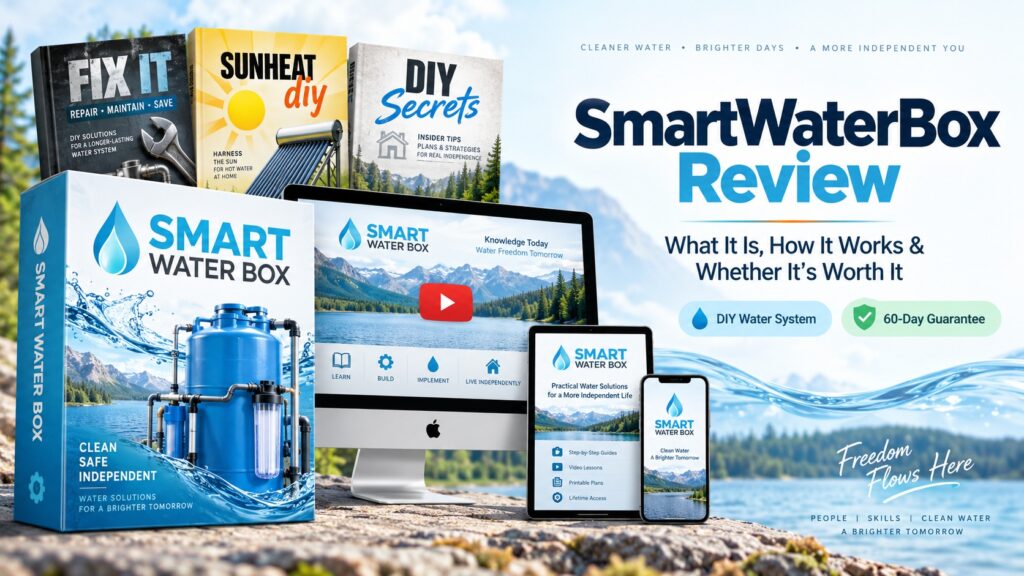
- Smart Water Box DIY construction guide and blueprints
- Materials and tools list
- Step-by-step build guidance
- Water safety and storage protocols
- Troubleshooting and upgrade information
- Lifetime support access
- SunHeat DIY Solar Water Heating Blueprint
- Home DIY Secrets
- 60-day money-back guarantee
The fact that the product is digital has one practical advantage for preparedness-minded buyers.
You can make redundant copies.
Download it locally.
Print it.
Keep another copy on offline storage.
Information intended for use when systems fail should not exist exclusively in the cloud.
Download the SmartWaterBox Guide and Bonuses
The Two SmartWaterBox Bonuses
The current package includes two additional guides.
SunHeat DIY Solar Water Heating Blueprint
This bonus covers a DIY approach to heating water with solar energy.
That has obvious appeal for cabins, homesteads and people interested in reducing dependence on gas or electric water heating.
It does not power the atmospheric water generator itself.
It addresses another piece of household water use: heating the water once you have it.
Home DIY Secrets
The second guide focuses more broadly on DIY household projects intended to reduce costs and improve household resilience.
That makes the bundle somewhat broader than atmospheric water generation alone.
SmartWaterBox Scam: Is Smart Water Box Legit?
The “SmartWaterBox scam” and “Smart Water Box scam” searches make sense once you see the advertising.
The sales presentation is intense.
It mixes atmospheric water generation with stories about suppressed military technology, government control, hidden systems and other dramatic claims.
I do not think you need any of those claims to make SmartWaterBox interesting.
Atmospheric water harvesting is openly studied.
AWGs exist.
Condensation is basic physics.
What SmartWaterBox actually sells is a DIY guide for building an atmospheric water generation system.
That is what I would judge.
The vendor also clearly states in its own disclaimer that the author name “James Anderson” is a pen name and that the product is informational and experimental rather than a commercially manufactured, technically assessed finished appliance.
That disclosure actually makes the correct expectations easier to establish.
You are buying plans.
You are building the project.
Your results depend on the finished build and environment.
The seller currently advertises a 60-day money-back guarantee if you decide the guide is not for you.
That makes the $39 experiment easier to consider.
Common Smart Water Box Reviews and Complaints
I would expect most legitimate SmartWaterBox complaints to revolve around expectations rather than the underlying science.
Someone expecting a finished machine may be disappointed when they discover they purchased instructions.
Someone living in an extremely dry environment may be disappointed if water production is much lower than the advertised maximum.
Someone uncomfortable with DIY electrical and mechanical work may find the project more involved than expected.
Someone expecting “free water” may also overlook the cost of electricity needed to operate a condensation system.
And anyone using atmospheric water for drinking still needs to pay attention to treatment, sanitation and maintenance.
Those are reasonable limitations.
None of them changes the fact that atmospheric water generation works.
They define where and how it works best.
What We Like About SmartWaterBox
The strongest part of SmartWaterBox is not the dramatic sales story.
It is the idea of decentralizing one more household resource.
Water normally arrives through infrastructure somebody else owns.
Electricity normally arrives through infrastructure somebody else owns.
Food normally arrives through long supply chains.
Self-reliance means gradually building alternatives.
Maybe you grow some food.
Maybe you generate part of your electricity with solar panels.
Maybe you collect rainwater.
Maybe you reduce household water consumption.
Maybe you store emergency water.
Atmospheric water generation fits naturally into that philosophy.
You do not have to disconnect from society and move into a cabin in the wilderness.
Even partial independence increases resilience.
Where SmartWaterBox Fits Into Sustainable Living
Sustainability gets reduced to buying eco-friendly products far too often.
Real sustainability is often much less glamorous.
Use fewer resources.
Waste less.
Repair what you own.
Understand where necessities come from.
Develop local alternatives.
Build systems that can keep functioning when centralized systems are under stress.
Water conservation is part of that.
Rainwater harvesting is part of that.
Greywater reuse can be part of that where appropriate.
Atmospheric water harvesting can be part of it too.
No single technique creates “water independence.”
But each additional source or conservation measure makes a household a little less fragile.
Who Should Consider SmartWaterBox?
SmartWaterBox looks particularly appealing for DIY-minded homeowners, homesteaders, cabin owners, RV enthusiasts, preparedness-minded families and people interested in sustainable or off-grid living.
It may also appeal to people who simply want to understand atmospheric water generation without spending thousands of dollars on a finished commercial machine.
You should be willing to build something.
You should also be willing to test it.
That last part matters.
A water system is only useful if you know what it does before you desperately need it.
Who Should Skip SmartWaterBox?
There are several situations where I would look elsewhere.
If you want a plug-and-play appliance, buy a finished atmospheric water generator.
If you have zero interest in DIY projects, this probably is not for you.
If you expect guaranteed 40-gallon daily output in every climate, reset that expectation before buying.
And if you need an emergency water source that functions with absolutely no electricity, prioritize stored water, gravity-fed filtration and other passive options first.
SmartWaterBox fills a particular role.
It does not need to replace every other water solution to be useful.
Frequently Asked Questions About SmartWaterBox
Is SmartWaterBox a physical product?
No. SmartWaterBox is a digital DIY guide that teaches you how to construct an atmospheric water generator. The required hardware must be sourced separately.
What is an atmospheric water generator?
An atmospheric water generator extracts water vapor from ambient air and converts it into liquid water. Condensation-based AWGs typically cool air below its dew point so moisture condenses onto a cold surface.
Does Smart Water Box really work?
The underlying technology works. Atmospheric water generation is real. Actual output from a DIY Smart Water Box will depend on factors such as humidity, temperature, system efficiency, power and construction quality.
Can SmartWaterBox produce 40 gallons of water per day?
The advertiser claims output of up to 40 gallons per day. That should be treated as a maximum advertised figure rather than a guaranteed daily output for every user or climate.
Does SmartWaterBox need city water?
The system is designed to collect atmospheric moisture, so the water-generation process does not require a connection to municipal water supplies.
Does SmartWaterBox need electricity?
A condensation-based atmospheric water generator typically requires power for cooling and airflow. Anyone pursuing true grid independence should plan an appropriate independent power source for the completed system.
Can SmartWaterBox work during a blackout?
Only if you have an appropriate way to power the system when utility electricity is unavailable.
Can SmartWaterBox work in an RV?
Potentially. Practicality will depend on the final size of the build, available electrical power, humidity, space and your desired daily water production.
Is SmartWaterBox good for camping?
It is probably more relevant to vehicle-supported camping, base camps, cabins and longer-term outdoor setups than ultralight backpacking.
Does SmartWaterBox work in low humidity?
Atmospheric water can still be harvested in dry conditions, but condensation-based systems generally become less productive as humidity declines. Local testing is important.
Is SmartWaterBox water safe to drink?
Atmospheric condensate should not automatically be assumed sterile or potable. Water intended for drinking needs appropriate treatment, sanitary collection and proper storage.
How much does the Smart Water Box cost?
The advertiser currently lists the digital SmartWaterBox guide for $39. The seller separately claims the physical system can be built for less than $106 in parts, although actual costs will vary.
Is SmartWaterBox a scam?
SmartWaterBox is based on the real concept of atmospheric water generation and sells a digital DIY construction guide. Some of its advertising is extremely dramatic, but the technology itself is legitimate. Buyers should evaluate the product as a DIY blueprint rather than as a finished appliance or a guarantee of unlimited water.
Does SmartWaterBox come with a guarantee?
The current offer advertises a 60-day money-back guarantee.
What bonuses come with SmartWaterBox?
The offer currently includes the SunHeat DIY Solar Water Heating Blueprint and Home DIY Secrets.
Our Final Take on SmartWaterBox
Water independence does not have to mean living completely disconnected from the municipal system.
That is an unrealistic goal for most people anyway.
A better objective is water resilience.
Keep stored drinking water.
Know how to filter and purify questionable water.
Conserve water before shortages force you to.
Capture rain where practical.
Understand your local natural water sources.
Develop backup energy.
And investigate technologies that can provide additional water when your primary source is unavailable.
SmartWaterBox belongs in that last category.
The underlying atmospheric water generation concept is real.
The guide is inexpensive enough to make the project accessible to DIY-minded buyers.
And unlike another case of bottled water, the objective is not merely to store a limited supply.
It is to learn how to create another potential source.
There are limitations.
Humidity matters.
Temperature matters.
Energy matters.
Water treatment matters.
And this is a build-it-yourself project rather than a finished appliance.
But those limitations do not erase the potential value.
They simply tell you how to use the idea intelligently.
For someone interested in outdoor self-reliance, sustainability, water conservation, drought preparedness, off-grid living or household water security, SmartWaterBox is an interesting project to add to the toolbox.
You do not need one perfect water solution.
You need enough options that losing one source does not leave you with none.
See the Current SmartWaterBox Offer
About the Author