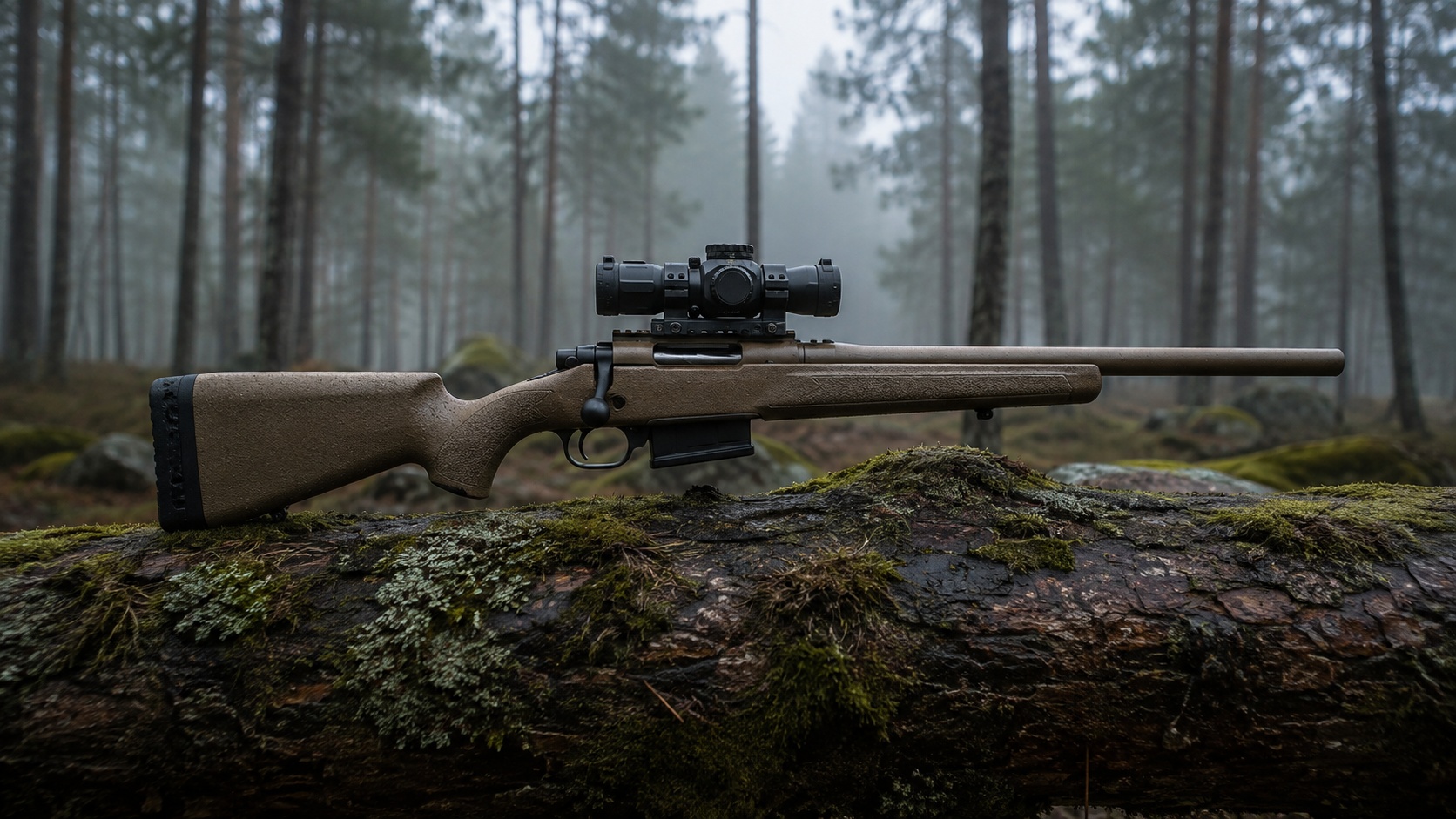
TLDR: Combat optics fall into six categories: red dot sights, holographic sights, prism scopes, low-power variable optics (LPVOs), red dot and magnifier combos, and pistol reflex sights. For survival and preparedness use, the most important factors are battery independence, environmental durability, zero retention, and weight. Prism scopes with etched reticles are the strongest choice for extended-field and preparedness builds because they function without batteries and provide fixed magnification with a permanently visible reticle. LPVOs offer more flexibility but add weight and cost. Red dots are the fastest option for close-range defensive use but require power. If you are building one rifle for an extended outdoor scenario, start with a fixed-power prism scope or an LPVO with an etched reticle, mounted on a quality QD mount with backup iron sights.
A combat optic on a survival rifle is not a luxury. It is a force multiplier for food, security, and situational awareness when the infrastructure you normally rely on is gone.
Most gun optics content is written for range shooters and competition guys. That audience has electricity, climate-controlled storage, easy access to batteries, and a bench rest 50 yards from their truck. If your optic needs to function after three weeks in a wet pack, after temperature swings from 20°F to 95°F, after being dropped on granite, and after the last CR2032 in your kit finally dies, the criteria change. Dramatically.
This guide evaluates every major type of combat optic through the lens of outdoor survival, preparedness, and extended field use. It explains what each type does well, what fails first, and how to choose the right optic for a rifle that may need to work for months without a trip to the gun shop. It also covers two things most optics guides skip entirely: how MOA and MRAD adjustment systems work, and why understanding them matters for field shooting beyond the range.
What Are Combat Optics?
Practical Definition
A combat optic is a firearm-mounted sight built for fast, reliable aiming under conditions that would destroy a standard range optic. Heat, cold, rain, dust, recoil, drops, and sustained use without maintenance access. The “combat” label does not mean the optic must be military-issued. It means the optic was designed for hard, unforgiving use where failure has real consequences.
For outdoor and survival applications, this definition expands. A combat optic on a backcountry or preparedness rifle also needs to tolerate long periods without battery replacement, function after rough transport, and survive the kind of casual abuse that comes from living with a rifle in the field rather than storing it in a safe.
Combat Optic Versus Standard Gun Optic
Standard gun optics and rifle optics are designed for controlled conditions. Combat optics are designed for everything else.
The differences that matter most for outdoor use:
- Durability. Impact-rated housings that survive drops on rock, not just recoil.
- Fast target acquisition. Illuminated reticles for both-eyes-open shooting. Critical for defensive encounters in the field or snap shots on game.
- Simple controls. Brightness dial. Maybe a magnification ring. Nothing that requires fine motor skills with cold, wet, or gloved hands.
- Reliable mounting. Picatinny (MIL-STD-1913) rail compatibility with quality QD mounts for removal and return-to-zero.
- Reticle visibility. Visible across the full range of outdoor lighting, from direct midday sun to predawn twilight.
- Environmental sealing. Waterproof, fogproof (nitrogen or argon purged), dust-sealed, and temperature-rated.
Military Designation Versus Marketing Term
Genuine military-issued combat optics carry formal designations backed by procurement contracts and operational deployment. The Aimpoint Comp M2 became the M68 Close Combat Optic (M68 CCO) for the U.S. Army. The Trijicon ACOG was designated the Rifle Combat Optic (RCO) by the USMC. The Sig Sauer Tango6T earned the Squad Combat Optic designation. These are documented systems with verified performance.
Civilian optics marketed as “tactical” or “combat-grade” are not automatically fraudulent, but they have not passed the same verification process. Evaluate them on evidence, not on box copy.
What Do Combat-Proven and MIL-SPEC Mean?
“Combat-proven” should mean deployed in actual military operations. Ask which contract, which branch, and for how long. If the answer is vague, the claim is decoration.
“MIL-SPEC” refers to a named military specification. MIL-STD-810 covers environmental testing (shock, vibration, temperature, humidity, altitude, sand, dust, rain). MIL-STD-1913 covers the Picatinny rail interface. A product called “MIL-SPEC” without naming the standard has told you nothing verifiable.
Combat Optics at a Glance
| Optic Type | Best Use | Magnification | Works Without Power? | Survival Suitability |
|---|---|---|---|---|
| Red dot sight | Close-range, general purpose | 1x | Usually no | Moderate |
| Holographic sight | CQB, magnifier pairing | 1x | No | Low (battery drain) |
| Prism scope | Preparedness, fixed magnification | 1x to 5x | Yes (etched reticle) | High |
| LPVO | Close-to-intermediate range | 1x to 6x, 8x, 10x | Yes (etched reticle) | High |
| Red dot with magnifier | Modular close-to-mid range | 1x + flip magnification | Usually no | Moderate |
| Pistol reflex sight | Optics-ready handguns | 1x | Usually no | Moderate |
Understanding MOA and MRAD for Field Use
Most combat optics guides ignore this entirely. For a range shooter zeroed at 100 yards on a calm day, it does not matter much. For a field shooter estimating distance, compensating for wind, or making a precision shot on game at 350 yards in the backcountry, understanding MOA and MRAD is essential.
What MOA Means
MOA stands for Minute of Angle. One MOA equals 1/60th of one degree of angle. At 100 yards, 1 MOA covers approximately 1.047 inches (commonly rounded to 1 inch). At 200 yards, 1 MOA covers about 2 inches. At 500 yards, about 5.24 inches.
MOA is the traditional adjustment system for American rifle optics. Most combat optics with turret adjustments use 1/4 MOA clicks. That means each click moves the point of impact approximately 0.25 inches at 100 yards, 0.5 inches at 200 yards, and so on.
MOA is intuitive for shooters who think in inches and yards. If your impact is 3 inches right at 100 yards, you need 12 clicks of left windage adjustment (3 inches ÷ 0.25 inches per click = 12 clicks).
What MRAD (Mils) Means
MRAD stands for milliradian. One mil equals 1/1000th of the distance to the target. At 100 yards, 1 mil equals 3.6 inches. At 100 meters, 1 mil equals 10 centimeters (3.94 inches).
Most mil-based optics use 0.1 MRAD clicks (1/10th of a mil per click). That means each click moves the point of impact 0.36 inches at 100 yards or 1 centimeter at 100 meters.
MRAD is the standard in most military and professional contexts outside the United States, and it is increasingly common in U.S. military combat optics. The math is simpler when working in metric units. It is also the standard used for range estimation with reticle subtensions, which matters for field shooting.
MOA Versus MRAD Comparison
| Feature | MOA | MRAD |
|---|---|---|
| Unit per click (common) | 1/4 MOA (0.25″) at 100 yds | 0.1 MRAD (0.36″) at 100 yds |
| Size at 100 yards | ~1.047 inches per MOA | ~3.6 inches per mil |
| Finer adjustment? | Yes (smaller increments) | Slightly coarser |
| Range estimation | Less intuitive | More intuitive with mil reticles |
| Common in U.S. hunting/sporting | Yes | Growing |
| Common in military/professional | Mixed | Dominant globally |
| Best for | Shooters thinking in inches/yards | Shooters needing ranging and holdover math |
Why This Matters for Outdoor and Survival Use
For close-range defensive use (under 100 yards), the adjustment system is mostly irrelevant. Your red dot is zeroed and you aim center mass.
For field shooting at unknown distances, MOA and MRAD start to matter. If your optic has a reticle with mil-based hash marks or BDC (bullet drop compensation) markings, you can estimate range by measuring the apparent size of a known object against the reticle. A deer’s chest is roughly 18 inches. If that 18-inch target spans 1 mil in your reticle, the deer is approximately 500 yards away (18 inches ÷ 0.036 inches per mil per yard × distance = range formula).
LPVOs and magnified prism scopes with BDC or mil-dot reticles give you this capability. A simple red dot does not. For a survival or backcountry rifle expected to take shots beyond 200 yards, a reticle with holdover references and a calibrated adjustment system is a practical advantage.
If you already think in MOA, stay with MOA. If you are starting fresh or building a preparedness rifle with range estimation in mind, MRAD is worth considering for its cleaner math at distance.
Types of Combat Optics Explained
Red Dot Combat Optics
Red dots are the baseline combat optic. Simple, fast, light. For close-range defensive shooting and snap shots inside 200 yards, nothing is faster.
How it works. An LED projects a dot onto a coated lens. The image is 1x (unmagnified). Both eyes stay open. The dot superimposes on the target.
Tube-style versus open reflex sights. Tube-style red dots (Aimpoint Comp M5, Vortex SPARC AR, Holosun 503 series) enclose the optical path. They are better sealed and generally more rugged. Open reflex sights (Trijicon RMR, Holosun 507 series) are smaller and lighter but expose the emitter to weather and debris.
Enclosed versus exposed emitters. Enclosed emitters protect the LED behind sealed glass. Exposed emitters leave it open to rain, mud, snow, and pine resin. For a rifle carried through brush, timber, and adverse weather, enclosed emitters are the better survival choice.
Dot size. A 2 MOA dot is the standard for rifle combat optics. It balances speed and precision. For a survival rifle that might engage game at 300 yards and defend a camp at 15 yards, 2 MOA is the best compromise. Pistol red dots typically run 3.25 MOA to 6 MOA for faster acquisition.
Battery runtime. This is where modern red dots shine for field use. The Aimpoint T-2 runs over 50,000 hours on a single CR2032. That is nearly six years of continuous operation. Holosun models with solar backup extend that further. For a preparedness rifle, extreme battery life partially offsets the red dot’s primary weakness (no reticle without power).
Mounting height. Absolute co-witness, lower one-third co-witness, or unity height. Choose based on your stock, cheek weld, and backup iron sight configuration.
Best applications for survival use. Close-range defensive rifle. Lightweight builds where every ounce matters. Secondary optic on an offset mount. Patrol and security roles in a group scenario.
Holographic Combat Optics
How holographic technology differs from a red dot. A holographic sight uses a laser to reconstruct a holographic reticle between two laminated glass panes. The reticle appears on the target plane and remains accurate even through damaged glass. EOTech dominates this category.
Circle-dot reticles. A large outer ring (65 to 68 MOA) for rapid close-range framing, with a 1 MOA center dot for precision. Effective for close quarter combat and fast target transitions.
Viewing window. Wider than most tube red dots. This matters for situational awareness in defensive scenarios.
Magnifier compatibility. Holographic reticles scale well with flip-to-side magnifiers, making the EOTech-plus-magnifier combo one of the most proven red dot and magnifier systems in military service.
Battery limitations for field use. This is the critical weakness. Holographic sights consume power far faster than LED red dots. EOTech models run 600 to 1,000 hours versus 50,000+ for an Aimpoint. In a sustained field scenario with limited battery resupply, holographic sights become a liability. Pack spare batteries and have a plan for when they run out.
Survival suitability rating: Low to moderate. Excellent optic, poor battery profile for extended field deployment.
Prism Combat Optics
For outdoor survival and preparedness, prism scopes are the strongest combat optic category. Period.
Etched reticles. The reticle is physically engraved into the glass. It does not require power. It does not require batteries. It is always there. In a scenario where you cannot resupply batteries for weeks or months, this single feature makes a prism scope the most resilient sighting system available.
Battery-independent use. Turn the illumination off. The reticle is still visible as a black pattern against whatever you are looking at. In daylight, dusk, or even moderate moonlight, the etched reticle works. Illumination is a convenience, not a requirement.
Fixed magnification. Most prism scopes are fixed at 1x, 2x, 3x, 4x, or 5x. The Trijicon ACOG 4×32 is the most famous, having served as the USMC Rifle Combat Optic for over a decade. It uses fiber optics for daytime illumination (powered by ambient light) and tritium for darkness (self-powered radioactive decay). No batteries. None. Ever. An ACOG operates in total darkness on a shelf for 10+ years and still has an illuminated reticle.
Other notable fixed-power prism combat optics include the Browe 4×32 Combat Optic (with automatic brightness adjustment), Primary Arms SLx prism scopes, Sig Sauer prisms, and Vortex Spitfire series.
Eye relief and eye-box limitations. Prism scopes require your eye to be at a specific distance behind the optic. Too close or too far, and the image vanishes. This fixed eye relief is less forgiving than a red dot, particularly in non-standard shooting positions (prone behind a log, shooting from inside a vehicle, shooting around obstacles). Practice with the optic before you need it.
Advantages for astigmatism. Because the reticle is etched into glass rather than projected by an LED, prism scopes produce a clean, sharp reticle regardless of astigmatism. If red dots look smeared or starburst-shaped to you, a prism scope eliminates the problem.
Survival suitability rating: High. Battery independence, durability, fixed magnification with etched reticle. The best combat optic class for long-duration field use.
Low-Power Variable Optics (LPVOs)
LPVOs are the Swiss Army knife of rifle combat optics. They bridge the gap between a 1x red dot and a fixed-magnification scope, giving you one optic that works from CQB distances to 400 or 600 yards.
The U.S. military has moved toward LPVOs aggressively. The USMC adopted the Trijicon VCOG 1-8×28 as its Squad Common Optic. The Army fielded the Sig Sauer Tango6T 1-6x as the Squad Combat Optic. Vortex developed the M157 1-8×30 for the Next Generation Squad Weapon. Variable optics are the present and future of military rifle optics.
Common magnification ranges. 1-4x, 1-6x, 1-8x, 1-10x. For a survival or preparedness rifle, a 1-6x LPVO is the best all-around choice. It provides enough magnification for target identification and game shooting out to 400 yards while remaining functional as a close-combat optic at 1x.
First versus second focal plane. First focal plane (FFP) scopes scale the reticle with magnification. BDC hash marks and mil-dot references stay accurate at any magnification setting. Second focal plane (SFP) scopes keep the reticle the same apparent size regardless of magnification. BDC and holdover references are only accurate at one power (usually max). For a survival rifle where you may need holdover data at various magnification settings, FFP is the better choice.
Illuminated and etched reticles. Quality LPVOs combine an etched glass reticle with battery-powered illumination. The etched reticle stays visible without power. The illumination provides a daylight-bright aiming point at 1x. This makes a good LPVO partially battery-independent: you lose the illuminated dot, but the reticle and all its holdover markings remain.
Close-range performance. At 1x, a quality LPVO should approximate the speed of a red dot for close-range use. The eye box is less forgiving. The weight is higher. But a 1x LPVO with a bright illuminated reticle handles close-range defensive shooting competently. Budget LPVOs often perform poorly at 1x, with narrow eye boxes and dim illumination.
Weight and complexity. An LPVO with mount typically weighs 16 to 28 ounces. That is significant weight for a rifle carried over miles of backcountry terrain. The magnification ring adds a manual step to engagement. For a lightweight survival build, the weight penalty of an LPVO may not be justified. For a general-purpose preparedness rifle that stays in a vehicle or camp, the added capability is worth the trade.
Survival suitability rating: High. Etched reticle works without batteries. Variable magnification covers close to intermediate distances. Weight is the primary drawback.
Red Dot and Magnifier Systems
A red dot with a flip-to-side magnifier provides 1x speed with optional magnification. Flip the magnifier in for target identification. Flip it aside for close-range work.
Flip-to-side magnifiers. Common magnifiers are 3x (EOTech G33, Vortex Micro 3x, Aimpoint 3XMag-1) and 6x (EOTech G45). They mount behind the red dot on their own hinged QD mount.
Advantages. At 1x, you have a pure red dot with unlimited eye relief. When you need magnification, one hand movement gets you there.
Limitations for field use. The combined setup is longer and heavier than a standalone red dot. The magnifier adds rail clutter. Alignment between magnifier and red dot must be precise. And the system is still battery-dependent for the reticle. If the red dot battery dies, the magnifier is useless because there is nothing to magnify.
Survival suitability rating: Moderate. Flexible, but lacks the battery independence of prism scopes and LPVOs with etched reticles.
Pistol Combat Optics
Pistol red dot sights are increasingly standard on defensive handguns. Modern optics-ready pistols from Glock, Sig Sauer, Smith & Wesson, Canik, Shadow Systems, Stoeger, and Wilson Combat ship with slides pre-milled for optic mounting.
Open versus enclosed emitters. Open-emitter sights (Trijicon RMR, Holosun 507C) are lighter but vulnerable to debris. Enclosed-emitter sights (Aimpoint Acro P-2, Holosun EPS) protect the LED from pocket lint, holster debris, and environmental contamination. For a sidearm carried in the field, enclosed emitters are the better choice.
Slide-mounted durability. A pistol optic absorbs punishing G-forces from slide cycling. Cheap red dots rated for rifle rails can shatter on a pistol slide within hundreds of rounds.
Optic footprints and plates. The Canik TTI Combat and Canik TP9 Elite Combat use plate-based mounting. The Canik TTI Combat optic footprint supports multiple plates for RMR, RMSc, and other patterns. Canik TTI Combat compatible optics depend on the installed plate. Direct-mount options for the Canik TTI Combat eliminate the plate for a lower profile. Canik TP9 Elite Combat optic plates provide similar flexibility.
The Shadow Systems MR920 Combat Optics Ready uses a multi-pattern milled cut. Wilson Combat ships optics-ready models including the EDC X9 Optic Ready, EDC X9 2.0 Optic Ready, SFX9 3.25 Optics Ready, SFX9 Optics Ready, SFT9 Optics Ready, Wilson Combat P320 Optic Ready, and the Wilson Combat True Zero Optic Plate system. The Stoeger STR-9S Combat Optics Ready 9mm pistol offers an entry-level optics-ready option. The Glock 34 Gen 5 Carry Optics Combat Master is a popular competition configuration.
Battery access. Top-loading trays preserve zero during battery changes. Bottom-loading requires unmounting. For a field sidearm, top-access matters.
Co-witness. Suppressor-height iron sights visible through the optic window provide backup aiming if the red dot fails. Standard recommendation for any defensive pistol.
How Combat Optics Have Evolved
Iron Sights to Red Dots
Iron sights require aligning a front post, a rear aperture, and the target across three focal planes. Under stress, in poor light, or on a moving target, this is slow. Red dot sights collapsed the process to one focal plane. One dot. Both eyes open. The U.S. Army’s adoption of the Aimpoint Comp M2 as the M68 Close Combat Optic (CCO) proved the concept at institutional scale. The M68 CCO reticle gave soldiers faster, more accurate fire in close combat and urban operations.
Fixed Magnification Combat Optics
The Trijicon ACOG brought magnification to the front-line infantryman without batteries. The ACOG 4×32 USMC Rifle Combat Optic for the M4 and M16 gave every Marine infantryman a magnified, environmentally sealed optic with an etched reticle, fiber-optic daytime illumination, and tritium night illumination. No batteries to die. No electronics to fail. ACOGs survived IED blasts and kept holding zero.
The Browe 4×32 Combat Optic added automatic brightness sensing. The M150 Rifle Combat Optic (an ACOG variant) served the Army. These fixed-power designs remain among the most combat-proven optics ever fielded.
Switchable and Variable Magnification
The demand for one optic covering CQB to 600 yards created the LPVO category. Early 1-4x models proved the concept. Modern 1-6x and 1-8x LPVOs from Trijicon (VCOG), Vortex (Razor, M157), Nightforce (ATACR), and Sig Sauer (Tango6T) now serve as primary rifle combat optics across multiple branches. Variable optics have largely replaced fixed-power ACOGs in active military inventory.
Modern Digital and Smart Optics
Emerging systems integrate digital rangefinding, ballistic calculation, and electronically enhanced reticles. Some overlay real-time aiming solutions. These are advancing rapidly but remain expensive, battery-hungry, and largely unproven for long-duration field deployment. For survival and preparedness applications, proven analog systems remain the safer bet.
Thermal imaging clip-on devices and dedicated thermal optics are separate technologies seeing increasing civilian availability. Thermal optics detect heat signatures through darkness, smoke, and foliage, but they are heavy, expensive, and battery-dependent.
What Makes an Optic Combat-Capable?
Zero Retention
If the optic does not hold its zero through recoil, drops, temperature changes, and rough transport, it is not a combat optic. Zero retention is the single most important performance requirement. Everything else is secondary.
For a survival or field rifle, this matters even more than for a range rifle. You may zero the optic in September and not have access to a range again until spring. The optic must hold that zero through months of use, transport, and environmental exposure.
Recoil and Impact Resistance
Look for documented G-force ratings, not vague durability claims. Aimpoint, Trijicon, Steiner, and Nightforce publish specific impact and recoil survival data. If a manufacturer says “built tough” without a standard to back it, assume they have not tested.
Environmental Protection
For outdoor and survival use, every one of these matters:
- Waterproof. O-ring sealed. Rated for submersion (1 meter minimum, deeper is better).
- Fogproof. Nitrogen or argon purged. Temperature transitions from a warm tent to freezing predawn air will fog an unpurged optic instantly.
- Dustproof. Sealed turrets, battery compartments, and adjustment mechanisms. Desert dust, volcanic ash, fine sand, pollen: all enemies.
- Temperature rated. Functional across -40°F to 120°F or wider. If your optic might see a Montana January and an Arizona July, verify the range.
- Shockproof. Beyond recoil. Drops onto rock. Being thrown in a pack. Bouncing in a vehicle.
Reticle Visibility
- Daylight brightness. The illuminated reticle must compete with direct sunlight. Many budget optics fail this test.
- Low-light visibility. The lowest brightness settings should not bloom or destroy dark-adapted vision. This matters for predawn hunts and security scenarios.
- Bloom. Excessive halo around a bright reticle in darkness. Quality optics control this through LED management and coatings.
- Etched-reticle fallback. On prism scopes and LPVOs, the etched reticle remains visible without power. On red dots and holographic sights, no power means a blank window.
Battery and Power Management
- Runtime. Red dots lead (50,000+ hours). Holographic sights trail badly (600 to 1,000 hours). LPVO and prism illumination falls between.
- Battery types. CR2032 and CR123A are the survival-relevant standards. Widely available. Lightweight. Long shelf life. Stockpile extras with your other preparedness supplies. My Patriot Supply and similar preparedness retailers carry batteries alongside food and water supplies.
- Motion activation. Holosun “Shake Awake” and similar systems extend battery life by activating only when the optic moves. Ideal for a rifle staged at a camp or in a vehicle.
- Automatic shutoff. Aggressive shutoff timers can leave your optic dark when you need it. Prefer long battery life with manual control over short battery life with auto-off.
- Battery replacement. Top-loading trays let you change the battery without removing the optic. This preserves zero. For a field rifle, this is a meaningful advantage.
- Performance without power. Red dots and holographic sights: no reticle. Prism scopes and LPVOs with etched reticles: full reticle, no illumination. Trijicon ACOGs with fiber optics and tritium: full illuminated reticle, no batteries required at all.
Mount Quality
A quality optic on a poor mount is a poor system. For field and survival use, the mount must survive everything the optic survives.
Rifle optic mounts from Scalarworks, Geissele, LaRue Tactical, Badger Ordnance, and Aero Precision are proven. QD (quick-detach) mounts allow removal and return-to-zero reinstallation. For a preparedness rifle, QD mounting is a practical advantage: you can remove the optic for cleaning, swap optics between rifles, or store the optic separately during long transport.
Controls and Maintenance
Brightness controls should work with gloves. Windage and elevation turrets should be capped and protected. Field cleaning requires non-abrasive lens cloths and proper solution. Wheeler Tools offers torque wrenches and mounting kits for proper optic installation. TekMat gun mats provide a useful field-cleaning surface.
Replacement parts (batteries, screws, turret caps, lens covers) must be available. An optic you cannot maintain in the field is a liability on a long trip.
Warranty and Manufacturer Support
Vortex offers an unconditional lifetime warranty. Aimpoint, Trijicon, and Steiner stand behind their products with documented warranty programs. For an optic expected to last years or decades, warranty and serviceability are part of the purchase decision.
How to Choose the Right Combat Optic
Intended Use
- Range use. Anything works. Controlled conditions are forgiving.
- Outdoor and field use. Environmental resistance, weight, battery life, and simplicity.
- Preparedness. Battery independence, redundancy, etched reticles, common batteries, durable mounts, common replacement parts.
- Home defense. Low-light performance, compact size, fast controls.
- Hunting. Magnification for identification. Light weight for carry. Clear glass. BDC or holdover references for shots beyond 200 yards.
- Competition. Speed and dot precision.
- Professional use. Duty-rated. Documented testing. Warranty support.
Expected Distance
Match magnification to realistic distances.
- Under 100 yards: 1x red dot is sufficient.
- 100 to 300 yards: 1x red dot with magnifier, or 1-4x/1-6x LPVO.
- 200 to 500 yards: 3x to 5x prism scope, or 1-6x/1-8x LPVO with BDC or mil-dot reticle.
- Beyond 500 yards: Dedicated long-range rifle scope. This exceeds the combat optic category.
Buying the highest magnification available because it sounds impressive is one of the most common mistakes in rifle optics. If 90% of your shots will be under 200 yards, a 1-10x LPVO is paying weight and money for capability you will rarely use.
Firearm and Mounting Platform
- Rifle (AR-15, AK, bolt action, PCC). Picatinny rail. Widest optic selection.
- Shotgun. Must survive heavy recoil. Keep it compact.
- Pistol. Footprint compatibility is the first and last question.
- Available rail space. Magnifiers need their own section of rail.
- Stock and cheek position. Mount height affects cheek weld.
- Existing iron sights. Co-witness preference determines mount height.
Lighting Conditions
Outdoor use means the full spectrum: blazing midday sun, dense forest shade, dusk, dawn, overcast, complete darkness. An optic for survival and field use must work across all of them. Daylight-bright illumination and low bloom at minimum settings are both essential. Fenix and Olight produce compact, high-output lights that complement optic-equipped firearms in low-light field conditions.
Shooter’s Eyesight
Astigmatism affects how LED-projected reticles appear. If red dots look smeared or distorted, test a prism scope or holographic sight before committing. The only reliable test is looking through the optic yourself. OpticsPlanet and Palmetto State Armory carry wide inventories with return policies that make testing practical.
Weight and Bulk
For a survival rifle carried over rough terrain, every ounce is felt. A red dot with mount: 5 to 8 ounces. An LPVO with mount: 16 to 28 ounces. That is the difference between a rifle you carry all day without complaint and one that wears you down.
Kryptek and 5.11 Tactical produce packs and carriers designed for rifle transport that account for optic-equipped firearms.
Acceptable Failure Mode
What happens when the battery dies and no replacement is available?
- Red dot / holographic sight: No reticle. You need backup iron sights.
- Prism scope with etched reticle: Full reticle visible. No illumination, but fully functional.
- LPVO with etched reticle: Full reticle visible across the magnification range. No illumination.
- Trijicon ACOG: Full reticle plus fiber-optic/tritium illumination. No batteries needed.
For a preparedness rifle, the acceptable failure mode is “the optic keeps working.” That points to prism scopes and LPVOs.
Best Combat Optics by Intended Role
Best for Close-Range Use
Red dots and holographic sights. Aimpoint Duty RDS, Holosun 403/503 series, Sig Romeo5, EOTech EXPS3. A 1x prism scope adds etched-reticle fallback.
Best for a General-Purpose Rifle
Three proven setups: red dot with 3x flip magnifier, 1-6x LPVO, or fixed 3x to 4x prism scope. For general purpose, the 1-6x LPVO offers the widest capability. The prism scope offers the most durability per dollar.
Best for Outdoor and Survival Use
Prism scopes with etched reticles. The Trijicon ACOG is the gold standard: no batteries, fiber-optic and tritium illumination, and a 20-year combat service record. For a lighter and more affordable option, the Primary Arms SLx 3x or 5x prism with an ACSS reticle provides BDC holdover references, etched-reticle battery independence, and solid environmental sealing.
Red dots with extreme battery life (Aimpoint T-2, CompM5; Holosun models with solar backup) are a secondary option for those who prioritize close-range speed over magnification.
Weight, environmental sealing, battery availability, and simple maintenance. Those are the survival priorities. Everything else is secondary.
Best for Preparedness
Redundancy is the priority. An optic with an etched reticle that functions without power. Backup iron sights. Common battery types stockpiled. QD mounts with spare screws. Simple maintenance protocols that work without a gunsmith.
Best for Home Defense
A compact red dot or holographic sight on a short carbine, PCC, or home-defense shotgun. Low-light performance is critical. Motion-activation ensures the optic is always ready. A forgiving sight picture beats maximum precision in a dark hallway at 3 a.m.
Best for Shooters With Astigmatism
Prism scopes with etched glass reticles. The etched reticle appears sharp regardless of astigmatism. Holographic sights are often (not always) cleaner than red dots for astigmatic shooters. Individual results vary. Look through the optic before committing.
Best Battery-Independent Option
Prism scopes with etched reticles win this category outright. The Trijicon ACOG goes further with fiber-optic and tritium illumination that never needs batteries. For a rifle expected to operate for months or years without resupply, this is the single most important optic feature.
Best Budget Combat Optic
At entry-level prices, Sig Romeo5, Holosun 403B/503CU, and AT3 Tactical red dots deliver functional combat performance. They hold zero. They seal adequately. They run on common batteries.
For budget-conscious buyers exploring the lowest price tier, MCG Tactical offers the Red Dot Stinger Combat Optic, Kodiak Combat Scope, and Warthog Tactical Scope as affordable starting points. The MCG Stinger Combat Optic has attracted some user attention at its price point, though long-term durability data remains limited compared to established brands.
Do not compromise on zero retention, basic sealing, or a functional mount at any price. A budget optic that holds zero is useful. One that does not is weight and an obstacle.
Choosing Combat Optics by Firearm Platform
AR-15 and Similar Rifles
The AR-15 is the most common combat optic platform. Its flat-top Picatinny rail accepts every optic type.
- Close range / defense: Red dot (Aimpoint, Holosun, Sig, Vortex)
- General purpose: Red dot with magnifier or 1-6x LPVO
- Preparedness / fixed magnification: Prism scope (ACOG, Primary Arms SLx, Browe 4×32 Combat Optic)
- Precision / flexibility: 1-8x or 1-10x LPVO (Vortex Razor, Nightforce ATACR, Trijicon VCOG)
AR-15 combat optics, close combat optics for M4 configurations, and AR-15 close combat optics represent the deepest product category in gun optics.
Shotguns
Shotguns punish optics with heavy, repeated recoil. Aimpoint Micro series, Holosun enclosed-emitter models, and Trijicon RMR units are proven on shotgun platforms. Simple reticles. Compact bodies. Nothing fragile.
Optics-Ready Pistols
Footprint compatibility first. Confirm the optic’s mount pattern matches the slide cut or available plate. Key platforms: Glock MOS, Sig P320/P365 series, Canik TTI Combat (Canik TTI Combat optics-ready semi-auto pistol), Canik TP9 Elite Combat (Canik TP9 Elite Combat optics ready), Shadow Systems MR920 Combat Optics Ready, Wilson Combat EDC X9 Optic Ready, Wilson Combat SFX9 Optics Ready, Stoeger STR-9S Combat Optics Ready, and the Glock 34 Gen 5 Carry Optics Combat Master.
For the Canik TTI Combat optic install and the Canik TTI Combat Mecanik optic system, verify plate compatibility before ordering. What optics fit Canik TTI Combat depends entirely on which plate or direct-mount cut is in use.
Specialized Platforms
AK-pattern rifles use side-rail or railed dust cover mounts. Lever actions accept scout-style forward mounts. Bolt-action survival rifles (Ruger American, Mossberg Patriot, etc.) use standard scope rings on Picatinny or Weaver bases. The optic selection principles are the same: durability, zero retention, environmental sealing, and a reticle you can use without batteries if necessary.
How to Compare Combat Optics Online
Specifications Versus Test Results
A spec sheet states a design target. A test result provides evidence. These are different things. When comparing combat optics, prioritize independent testing, documented military adoption, and long-term user reports over manufacturer marketing.
Questions Every Review Should Answer
- What firearm was the optic mounted on?
- What mounting system was used?
- How many rounds were fired?
- Was zero checked before and after testing?
- Were failures or limitations documented?
- Were conditions described (weather, temperature, lighting)?
Counterfeit and Unauthorized Seller Risks
Fake Trijicon ACOGs, counterfeit Aimpoint T-2 units, and knockoff EOTech holographic sights exist on third-party marketplaces. They look real. They fail under use. Buy from authorized dealers: OpticsPlanet, Palmetto State Armory, MDGuns.com, and Guns.com carry verified inventory.
Return Policy Versus Manufacturer Warranty
A retailer’s return window covers the initial purchase. A manufacturer’s warranty covers years or decades of service. Check both.
Mounting, Testing, and Maintaining a Combat Optic
Confirm Compatibility
Verify rail type, mounting footprint (pistol optics), plate and screw requirements, mount height, and available rail space before purchasing.
Follow Manufacturer Instructions
Use specified torque values. Use a torque wrench. Wheeler Tools manufactures torque wrenches specifically for optic mounting. Apply thread-locking compound as directed (typically Loctite Blue 242). Over-torquing cracks housings. Under-torquing lets the optic shift.
Establish and Record a Zero
Zero the optic at a known distance with the ammunition you intend to use. Record windage and elevation settings, ammunition type, distance, and conditions. Photograph the settings if possible. This is your baseline.
Recheck Zero Retention
Verify after transport, extended shooting, drops, impacts, and seasonal temperature changes. For a preparedness rifle, schedule periodic zero checks even if the rifle has not been fired.
Test the Failure Mode
Remove the battery. Turn off illumination. Can you still aim? On prism scopes and LPVOs, the etched reticle should be visible. On red dots, you should see co-witnessed iron sights. If neither works, you have a single point of failure in your system.
Inspect and Maintain the System
Periodically check lens surfaces, mount fasteners, battery status, turret caps, and overall alignment. Replace batteries on a schedule. Carry spares. A small field maintenance kit (lens cloth, spare screws, spare battery, thread locker) weighs almost nothing and prevents problems.
Frequently Asked Questions About Combat Optics
What Is a Combat Optic?
A firearm-mounted sighting system engineered for reliable aiming under harsh conditions including recoil, weather, temperature extremes, and rough handling. Must hold zero, provide a visible reticle, and survive sustained field use.
What Is the Best Combat Optic for an AR-15?
For close-range defense: a quality red dot. For general purpose: a 1-6x LPVO or red dot with 3x magnifier. For preparedness: a prism scope (Trijicon ACOG or Primary Arms SLx). The best combat optics for AR-15 builds depend on intended use, engagement distance, and battery priorities.
What Is the Difference Between a Red Dot and a Combat Optic?
A red dot is one type of combat optic. “Combat optic” is the umbrella term covering red dots, holographic sights, prism scopes, LPVOs, and magnifier systems. Not every red dot qualifies as a combat optic.
Are Holographic Sights Better Than Red Dots?
Holographic sights offer wider viewing windows and better magnifier pairing. Red dots offer dramatically longer battery life, lighter weight, and lower cost. For sustained field use, red dots are usually more practical. For CQB, holographic sights have a slight edge.
Are Prism Optics Better for Astigmatism?
Generally, yes. Etched glass reticles appear sharp regardless of astigmatism. Individual variation exists. Test the optic before committing.
Are LPVOs Used for Close-Range Shooting?
Yes. A quality LPVO at 1x approximates a red dot for close-range use. The eye box is less forgiving and the weight is higher, but a daylight-bright illuminated reticle at 1x handles close-range defensive shooting.
What Combat Optics Does the Military Use?
Current U.S. military combat optics include the Aimpoint CompM2/M4/M5 (M68 Close Combat Optic), Trijicon ACOG (Rifle Combat Optic), EOTech holographic sights, Trijicon VCOG 1-8×28 (USMC Squad Common Optic), Sig Sauer Tango6T 1-6x (Army Squad Combat Optic), Vortex M157 1-8×30, and the Trijicon RMR on select handguns. Navy SEALs, Army Special Forces, and Delta Force select optics by mission. Common choices include Aimpoint, EOTech, Nightforce, and Trijicon products.
What Does Combat-Proven Mean?
Documented deployment in actual military operations. Traceable contract, military designation, and verifiable service record. If those details are missing, the term is marketing.
Do Combat Optics Need Backup Iron Sights?
For survival, field, and defensive use: yes. Co-witnessed iron sights or offset backup sights provide a fallback when the primary optic fails.
How Much Should a Reliable Combat Optic Cost?
Entry-level combat red dots: $120 to $200. Mid-tier proven options: $400 to $900. Premium military-contract optics: $1,000 to $3,000+. The mount adds $50 to $300.
Can a Pistol Red Dot Be Mounted on a Rifle?
Generally not recommended. Pistol optics are designed for slide-cycling recoil, not the sustained concussion profile of rifle operation. Use rifle-rated optics on rifles.
How Long Should a Combat Optic Battery Last?
Red dots: minimum 10,000 hours (quality models exceed 50,000 hours). Holographic sights: 600 to 1,000 hours. Illuminated prism scopes and LPVOs: 100 to 500 hours. Etched reticles function indefinitely without power.
What Is the Difference Between MOA and MRAD?
MOA (Minute of Angle) equals approximately 1.047 inches at 100 yards. Most American sporting optics use 1/4 MOA click adjustments. MRAD (milliradian) equals 3.6 inches at 100 yards (or 10 cm at 100 meters). Most military and professional optics use 0.1 MRAD clicks. Both work. MOA offers finer adjustment increments. MRAD offers cleaner math for range estimation and holdover at distance.
Final Action Review
No single combat optic is the right answer for every rifle, every distance, and every scenario. Choosing correctly means defining the job first and then matching the optic to it, not the other way around.
For outdoor survival and preparedness: battery independence is the priority. Prism scopes with etched reticles, LPVOs with etched reticles, and the Trijicon ACOG’s battery-free illumination system are the strongest options. They work when power is not available. They survive rough conditions. They hold zero.
Red dots are the fastest, simplest, and lightest option for close-range use. Holographic sights offer the widest sight picture. LPVOs offer the most flexibility. But only etched-reticle optics keep working when the batteries are gone and the nearest store is a hundred miles away.
Zero retention, durable mounting, and environmental sealing are non-negotiable across every category. The optic and the mount are one system. Test them together. Verify zero. Confirm the failure mode. Train with the setup.
If you are building one rifle for extended outdoor use and can only choose one optic, a fixed-power prism scope between 3x and 5x with an etched reticle, on a quality QD mount, with co-witnessed backup iron sights, is the most resilient configuration available. Everything else builds from there.
About the Author